
How technology, economics, and modern life have changed the way we create beauty.
Throughout history, humans have expressed beauty through ornament, detail, and color. Medieval architecture featured intricate stone carvings, illuminated manuscripts, and stained glass. The Baroque and Rococo periods celebrated elaborate decoration, while the Victorian era brought ornamental detail into architecture, furniture, and everyday objects.
Industrialization, beginning in the late eighteenth century, gradually transformed how things were made. Efficiency, standardization, and mass production became increasingly important. By the twentieth century, Modernism had embraced functionality, rationality, and simplicity, often rejecting ornament as unnecessary. Its influence remains visible in contemporary design, particularly in minimalism.
But have we truly lost our appreciation for beauty, or have modern conditions simply changed how we create it—and which forms of beauty we choose to preserve?
Consider an old wooden door covered in intricate carvings, patterned ceramic tiles, colorful vintage posters, or a historic building adorned with decorative details.
Now compare them with their modern counterparts: flat-panel doors, neutral interiors, geometric buildings, and products designed with minimal decoration.
The difference is not merely stylistic. Some objects reflect a deep investment in craftsmanship, detail, and visual expression, while others prioritize practical needs.
It is tempting to conclude that the past was more beautiful or that modern people have lost their aesthetic sensibilities. But perhaps the reality is more complicated. We may not have lost our ability to create beauty. Instead, we may have gradually changed the conditions that allow certain forms of beauty to flourish.
Technology Has Expanded Our Choices
Every technological advancement creates new possibilities. Skills that once required years of manual practice can now be developed with digital tools. Creativity has expanded into graphic design, digital illustration, animation, filmmaking, and video game development.
Imagine if motorcycles had existed centuries ago. Some people who might otherwise have pursued traditional crafts could have chosen to spend their time modifying engines instead. The same applies to photography, cinema, and countless other modern activities.
This does not mean people have become less creative. They simply have more ways to express their creativity.
However, this expansion comes with a trade-off. When fewer people practice a particular craft, fewer remain capable of teaching it. Knowledge once passed down through generations can gradually disappear.
Decorative metalwork, intricate carving, traditional lettering, and textile crafts may survive, but increasingly within specialized communities rather than everyday life.
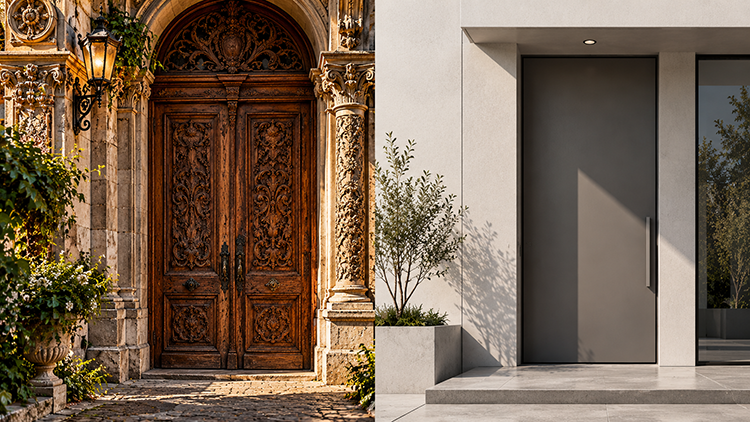
Technology does not necessarily eliminate creativity. It changes where creativity is directed—and sometimes which traditions survive.
When Survival Takes Priority
Imagine someone furnishing their first home. They have a mortgage to pay, a family to support, and savings to build. An intricately carved wooden door might be more beautiful, but an affordable, unadorned alternative may be the more sensible choice.
This is where economics enters the picture.
Decorative craftsmanship requires specialized skills, time, and sometimes expensive materials. When resources are limited, beauty becomes something people must weigh against other necessities.
Someone can genuinely appreciate carved furniture while choosing a simpler alternative because it costs less, requires less maintenance, or better suits their living space. Their taste has not necessarily changed. Their priorities have.
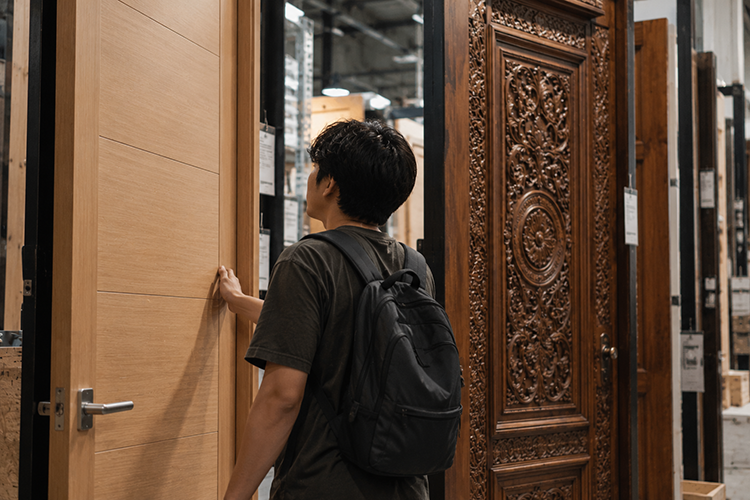
Mass production emerged partly as a way to meet growing demand by making goods available in greater quantities and at lower prices. Products that are easy to manufacture and distribute consequently became more accessible.
As demand for certain crafts declines, artisans struggle to sustain their livelihoods. What disappears is not merely a type of product, but potentially the skills, knowledge, and traditions behind it.
Choosing practicality does not mean abandoning beauty. Sometimes, practicality is simply the more affordable option.
When Efficiency Becomes the Standard
Modern manufacturing has made countless products cheaper, more consistent, and easier to obtain. These are genuine achievements.
The problem begins when efficiency stops being one consideration among many and becomes the primary standard for design.
Flat surfaces are easier to clean than carved ones. Simple geometric furniture is easier to manufacture, package, and transport. Products with fewer decorative details are often easier to standardize.
Applied across thousands of products, these considerations can gradually make everyday objects look increasingly alike.
Capitalism is not inherently opposed to ornament. Luxury goods, elaborate jewelry, and decorative architecture can thrive in commercial markets. However, mass production creates strong incentives to reduce costs and appeal to the widest possible audience.
Minimalism often aligns with these incentives. Simple forms can be reproduced consistently across products, retail spaces, packaging, and digital platforms. When this approach succeeds commercially, other companies have reasons to follow.
Over time, what began as a practical decision can become a cultural expectation. We see similar forms so frequently that they begin to feel like the natural language of modern design.

Minimalism itself is not the problem. Simplicity can be elegant, sophisticated, and artistically compelling. There is, however, a difference between removing details because they weaken a design and removing them because they are considered too expensive or commercially unnecessary.
When efficiency becomes the answer to every design problem, we risk forgetting that not everything valuable needs to be efficient.
Art Nouveau, Art Deco, Modernism, and Postmodernism: How Beauty Changes
Design history shows that every era develops its own visual language. What appears modern in one period may seem outdated in another. A change in aesthetic preference does not automatically mean that beauty has disappeared.
Consider the transition from Art Nouveau to Art Deco.
Art Nouveau, which flourished primarily between 1890 and 1914, embraced organic lines, botanical motifs, decorative ornament, and the integration of art into everyday life. Its influence appeared in architecture, furniture, posters, stained glass, and typography.
Art Deco gained prominence during the 1920s and 1930s, offering a different visual language characterized by geometric forms, symmetry, bold lines, repetitive patterns, and glamour associated with modernity and machine-age culture.
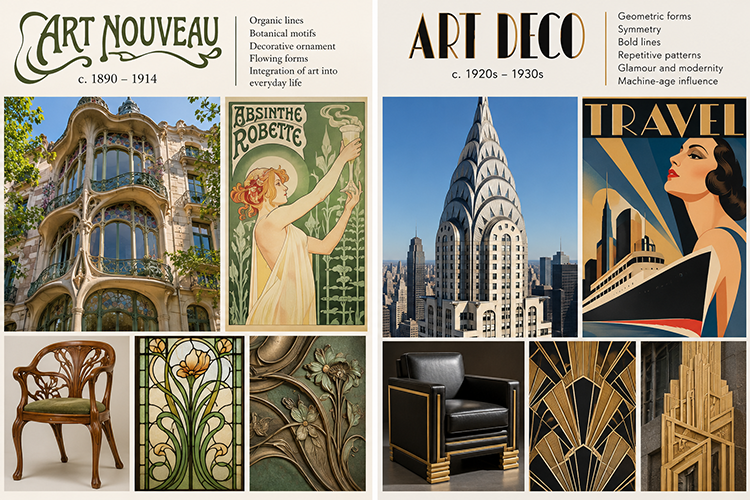
Art Deco was not simply a rebellion against Art Nouveau; both movements emerged from complex artistic and cultural influences. Nevertheless, their differences demonstrate how societies can move away from one visual language and develop another.
The capacity to create beauty remained. Its expression changed. Art Deco was still decorative, but its ornamentation had a different character.
A similar relationship can be seen between Modernism and Postmodernism.
Modernism, which developed across various disciplines from the late nineteenth century and became particularly influential during the early and mid-twentieth century, emphasized rationality, function, structure, and simplified forms. In architecture, these principles often produced clean geometries, minimal ornament, and an emphasis on industrial materials.
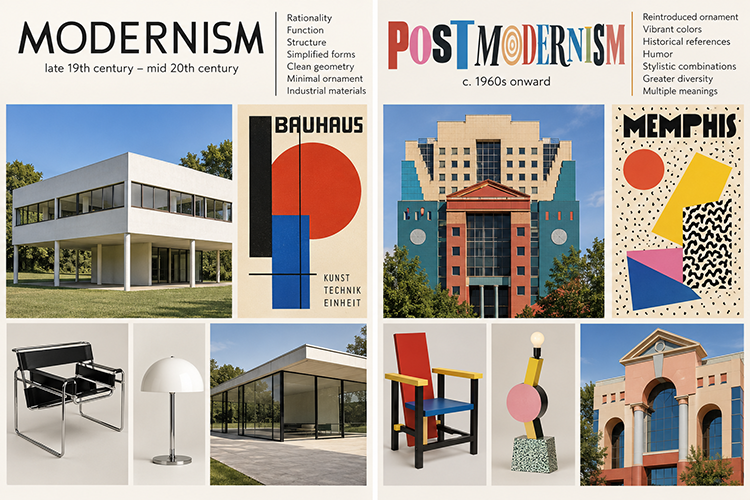
Modernism generated influential and enduring work. Yet as certain modernist principles became dominant, critics argued that the resulting environments could feel monotonous, impersonal, or disconnected from historical character.
Postmodernism emerged, particularly from the 1960s onward in architecture and design, partly in response to these limitations. Some designers reintroduced ornament, vibrant colors, historical references, humor, and stylistic combinations that modernist principles had often discouraged.
Where Modernism frequently sought universal design principles, Postmodernism embraced a greater diversity of meanings and visual references.
Neither transition proves that the preceding movement was a mistake. Art Deco did not erase the beauty of Art Nouveau, and Postmodernism did not invalidate Modernism. These movements demonstrate that aesthetics evolve through experimentation, criticism, and the search for alternatives.
The problem is not that one style replaces another. It is when only a narrow range of aesthetic approaches is allowed to thrive.
Simplicity can be a powerful artistic choice, but it can also become a limiting habit when applied indiscriminately.
Where Has the Color Gone?
Look at contemporary homes, offices, vehicles, electronic devices, and everyday products. White, black, gray, and beige dominate many categories.
Now consider patterned ceramic tiles, stained glass, vintage posters, decorated porcelain, colorful textiles, and historic building facades. In these examples, color is integral to an object’s identity.
Color is more than a decorative layer. It establishes character, creates atmosphere, and makes objects recognizable.
Of course, not everything in the past was colorful. Certain pigments were expensive, and some historic buildings and sculptures have lost their original colors over time. Nevertheless, many visual traditions demonstrate the importance of color in human expression.
Why, then, do so many modern products favor restricted palettes?
One reason is commercial practicality. Neutral colors are perceived as versatile, easy to coordinate, and less likely to feel outdated. Consumers may worry that bold colors will become tiresome or make it harder to change their surroundings later.
Manufacturers therefore tend to favor colors that appeal to the broadest possible market. As more companies make similar decisions, neutral palettes become increasingly common.
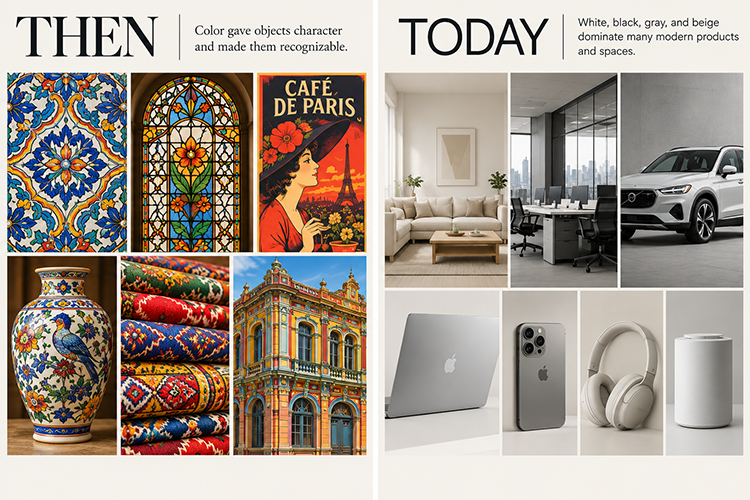
Minimalism reinforces this tendency. Restricted palettes can create a sense of calm, cleanliness, and order. But when the same approach appears in homes, stores, vehicles, and everyday products, our visual environment risks losing some of its diversity.
The irony is that modern technology allows us to produce and reproduce millions of colors with remarkable precision. Our technical capabilities have expanded, yet many products still favor the safest and most conventional choices.
Perhaps the world has not lost its color. We have simply become more selective about using it.
The issue is not whether every object should be brightly colored. Neutral colors have their own beauty. The question is whether we choose them because they genuinely serve the design or because they seem like the safest commercial option.
Our Attention Has Shifted
After work, people can play video games, watch films, explore social media, or develop entirely new skills. Each activity offers its own form of enjoyment and fulfillment.
With so many alternatives available, fewer people may choose to spend thousands of hours mastering a traditional craft.
There is no reason to blame someone for choosing digital animation over traditional illustration. However, individual choices can have collective cultural consequences. When fewer people practice a skill, opportunities to pass on that knowledge also diminish.
Our aesthetic preferences are influenced by what we encounter regularly. Familiar forms begin to feel natural, while styles, ornaments, and colors that become less common may start to seem old-fashioned or unfamiliar.
As a tradition fades, society loses more than the objects it once produced. It also loses opportunities to understand the knowledge, labor, and creativity involved in making them.
Typography: When Letters Become More Functional
Typography offers a particularly interesting example of the relationship between craftsmanship and modern life.
Calligraphy developed through the movement of the hand and the characteristics of writing instruments. Traditional type production required the expertise of type designers, punchcutters, type founders, and printers.
Digital technology transformed how typefaces are designed, produced, and distributed. Today, designers can access thousands of typefaces for an extraordinary range of purposes.
This is a remarkable achievement. Yet many contemporary applications demand typography that is legible, consistent, and unobtrusive.
Consequently, expressive typography may occupy less space in everyday communication. Ornamental typefaces, decorative lettering, and blackletter may not suit every interface or long-form text, but they retain considerable artistic value in posters, branding, packaging, and display design.
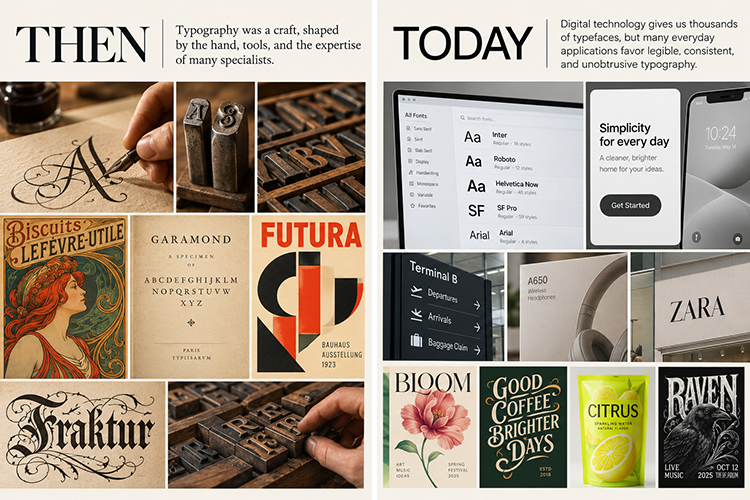
There is also a difference between having access to thousands of fonts and actually using that diversity. Designers working under time pressure often choose familiar typefaces or options considered commercially safe.
We possess technology capable of supporting enormous typographic diversity, yet our work can still end up looking remarkably similar.
We have more opportunities than ever to create distinctive typography. Technology alone, however, cannot guarantee that we will choose to do so.
What Should Progress Preserve?
Perhaps the more useful question is not whether the past was more beautiful.
The past produced extraordinary craftsmanship, but it also contained poverty, inequality, and significant limitations. Modern design, meanwhile, has delivered genuine improvements in affordability, accessibility, and creative freedom.
We do not need to romanticize the past or reject modern life.
However, practicality is not the only measure of a good life. A carved door does not need to be more practical than a plain one to deserve preservation. An ornamental typeface does not need to be more readable than a neutral typeface to possess artistic value. Bold colors do not need to be more beautiful than neutral ones to deserve a place in our surroundings.
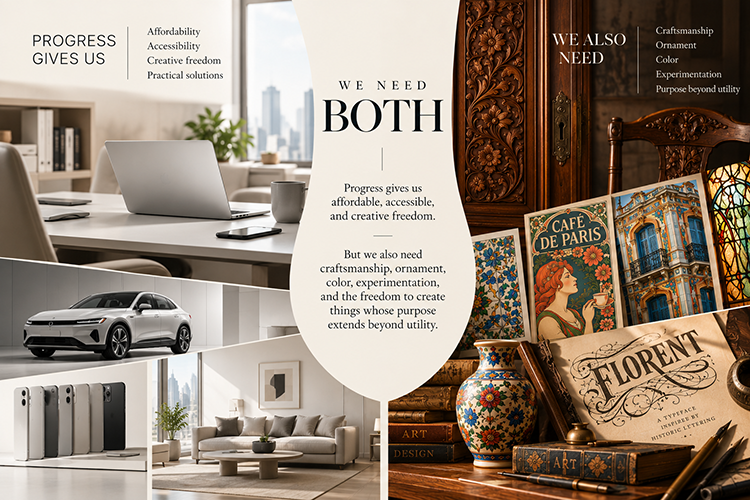
Sometimes, the value of an object lies in the details we notice, the skills we preserve, the history we encounter, or the pleasure of living among things made with care.
We need efficient products, accessible design, and practical solutions. But we also need craftsmanship, ornament, color, experimentation, and the freedom to create things whose purpose extends beyond utility.
Beauty does not always need to justify itself through productivity.
Conclusion: Beauty Requires More Than the Ability to Create It
Perhaps the world has not lost its ability to create beauty. Perhaps it has gradually changed the conditions that allow certain forms of beauty to flourish.
Technology expands our possibilities. Economic pressures influence our priorities. Mass production makes goods more affordable. Practicality becomes increasingly important, while human attention shifts toward new interests. Even the colors that surround us can be shaped by commercial decisions and prevailing trends.
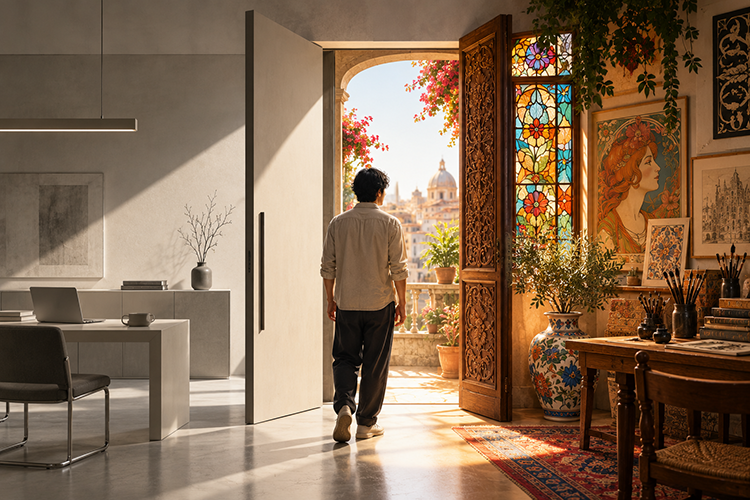
The histories of Art Nouveau, Art Deco, Modernism, and Postmodernism remind us that changing styles are a natural part of design evolution. Beauty does not have to mean elaborate ornament or vivid color. It can exist in simplicity as well as complexity.
What deserves our attention is whether modern society continues to make room for diverse aesthetic possibilities or increasingly favors whatever is most efficient, familiar, and commercially safe.
A simple door makes sense. A practical product makes sense. A neutral typeface makes sense. A commercially safe color makes sense.
But when these choices accumulate across our surroundings, their collective effect deserves closer examination.
Progress should give us more possibilities, not gradually convince us that only a handful are worth preserving.
Perhaps progress should be measured not only by how much we can produce or how efficiently we live, but also by whether we retain the time, skills, and cultural space to create things that make life more beautiful—through form, detail, typography, and color—even when those things do not strictly need to exist.